Media Summary: What is a conjunction (in logic) and how can the truth-value of propositions connected by logical AND be defined? Within less ... What are adjuncts, how can we define them according to a traditional view and how are they defined in X'-syntax? Within less ... What is a negation (in logic) and how can the truth-values of this unary logical connective be defined? Within less than two ...

Syn 010 Linguistic Micro Lectures - Detailed Analysis & Overview

What is a conjunction (in logic) and how can the truth-value of propositions connected by logical AND be defined? Within less ... What are adjuncts, how can we define them according to a traditional view and how are they defined in X'-syntax? Within less ... What is a negation (in logic) and how can the truth-values of this unary logical connective be defined? Within less than two ... What is sonority and how can speech sounds be defined in terms of this major-class feature? These questions are in the center of ... What are complements, how can we define them in a traditional fashion and how are they defined in X'-syntax? Within less than ... What is a phrase and what are their component parts? Within less than two minutes Prof. Handke explains the most important ...

What is a equivalence (in logic) and how is it used? Within less than two minutes Prof. Handke discusses and exemplifies the ... What is an archiphoneme, how is it represented and what is the fundamental concept behind it? Within just two minutes, Prof. What are diphthongs? Within less than two minutes Prof. Handke explains the articulation and classification of diphthongs ... How can objects of sentences be realized formally and how can we identify them? These two questions constitute the focus of Prof ... Rhotic vs. Non-Rhotic? Or degrees of Rhoticity? Within just over a minute, Prof. Handke discusses this important parameter for the ... What are ergative constructions, how are they realized in PDE and how can they be distinguished from standard sentences?

Photo Gallery

SEM_010 - Linguistic Micro-Lectures: Conjunction (Logic)
SYN_010 - Linguistic Micro-Lectures: Adjuncts
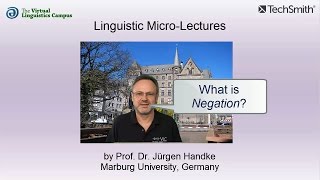
SEM_014 - Linguistic Micro-Lectures: Negation (Logic)
PHO_016 - Linguistic Micro-Lectures: Sonority
SYN_014 - Linguistic Micro-Lectures: Complements
SYN_017 - Linguistic Micro-Lectures: Phrases
SEM_012 - Linguistic Micro-Lectures: Equivalence (Logic)
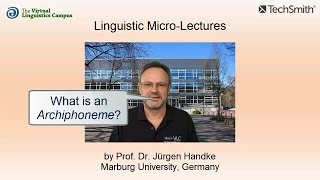
PHY_013 - Linguistic Micro-Lectures: Archiphonemes
MOR_022 - Linguistic Micro-Lectures: Neoclassical Compounds
SYN_020 - Linguistic Micro-Lectures: Syntactic Trees
PHO_012 - Linguistic Micro-Lectures: Diphthongs
SYN_022 - Linguistic Micro-Lectures: The Object
View Detailed Profile
SEM_010 - Linguistic Micro-Lectures: Conjunction (Logic)

SEM_010 - Linguistic Micro-Lectures: Conjunction (Logic)

What is a conjunction (in logic) and how can the truth-value of propositions connected by logical AND be defined? Within less ...

SYN_010 - Linguistic Micro-Lectures: Adjuncts

SYN_010 - Linguistic Micro-Lectures: Adjuncts

What are adjuncts, how can we define them according to a traditional view and how are they defined in X'-syntax? Within less ...

SEM_014 - Linguistic Micro-Lectures: Negation (Logic)

SEM_014 - Linguistic Micro-Lectures: Negation (Logic)

What is a negation (in logic) and how can the truth-values of this unary logical connective be defined? Within less than two ...

PHO_016 - Linguistic Micro-Lectures: Sonority

PHO_016 - Linguistic Micro-Lectures: Sonority

What is sonority and how can speech sounds be defined in terms of this major-class feature? These questions are in the center of ...

SYN_014 - Linguistic Micro-Lectures: Complements

SYN_014 - Linguistic Micro-Lectures: Complements

What are complements, how can we define them in a traditional fashion and how are they defined in X'-syntax? Within less than ...

SYN_017 - Linguistic Micro-Lectures: Phrases

SYN_017 - Linguistic Micro-Lectures: Phrases

What is a phrase and what are their component parts? Within less than two minutes Prof. Handke explains the most important ...

SEM_012 - Linguistic Micro-Lectures: Equivalence (Logic)

SEM_012 - Linguistic Micro-Lectures: Equivalence (Logic)

What is a equivalence (in logic) and how is it used? Within less than two minutes Prof. Handke discusses and exemplifies the ...

PHY_013 - Linguistic Micro-Lectures: Archiphonemes

PHY_013 - Linguistic Micro-Lectures: Archiphonemes

What is an archiphoneme, how is it represented and what is the fundamental concept behind it? Within just two minutes, Prof.

MOR_022 - Linguistic Micro-Lectures: Neoclassical Compounds

MOR_022 - Linguistic Micro-Lectures: Neoclassical Compounds

In this short

SYN_020 - Linguistic Micro-Lectures: Syntactic Trees

SYN_020 - Linguistic Micro-Lectures: Syntactic Trees

In this short

PHO_012 - Linguistic Micro-Lectures: Diphthongs

PHO_012 - Linguistic Micro-Lectures: Diphthongs

What are diphthongs? Within less than two minutes Prof. Handke explains the articulation and classification of diphthongs ...

SYN_022 - Linguistic Micro-Lectures: The Object

SYN_022 - Linguistic Micro-Lectures: The Object

How can objects of sentences be realized formally and how can we identify them? These two questions constitute the focus of Prof ...

PHY_021 - Linguistic Micro-Lectures: Rhoticity

PHY_021 - Linguistic Micro-Lectures: Rhoticity

Rhotic vs. Non-Rhotic? Or degrees of Rhoticity? Within just over a minute, Prof. Handke discusses this important parameter for the ...

SYN_015 - Linguistic Micro-Lectures: Ergatives

SYN_015 - Linguistic Micro-Lectures: Ergatives

What are ergative constructions, how are they realized in PDE and how can they be distinguished from standard sentences?