Media Summary: THIS INTRODUCTION MODULE IS OUT OF DATE This is the course overview for Induction as a means to prove proposed formulas and some useful formulas that count the number of computations before they ... Introduction to Numeric Systems and Computation.

Oit Math 451 Session 0 - Detailed Analysis & Overview

THIS INTRODUCTION MODULE IS OUT OF DATE This is the course overview for Induction as a means to prove proposed formulas and some useful formulas that count the number of computations before they ... Introduction to Numeric Systems and Computation. Understanding the nature of our modern definition of numbers. Numeric representations on moder computers. Computational methods for matrices; understanding matrix singularity and rank.

Moving among binary, octal, decimal and hexadecimal number systems in preparation for developing the floating point real ... Improving the "Method of Exhaustion" by substituting rectangles with trapezoids. Reducing the computations needed through the use of linked lists. We will also learn to calculate the cost of algorithms by ... Improving the first order method by making use of multiple stages and locations for calculating the derivative. Speed of Convergence for the Bisection Method. Improvements to the Bisection Method resulting in the False Position and ... Developing the Newton-Raphson Method to find a root of a single non-linear equation.

Analysis of the Newton-Raphson Algorithm with respect to multiple roots and issues when the function is flat near the root of ... Applying Richardson's method to the trapezoidal rule to obtain Romberg Integration. Adapting the Newton-Raphson to case where the function being evaluated is available only in table form.

Photo Gallery

OIT Math 451 section 0 0   summer 2017
OIT Math 451 section 0.0: Introduction and Logistics
OIT Math 451 session 0.1c: Preliminaries : Counting & Induction
OIT Math 451 section 0.1a: The Origins of Computation
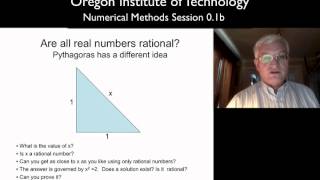
OIT Math 451 session 0.1b: Preliminaries - rational & irrational numbers
OIT Math 451 session 0.2: Algorithms as Solutions
OIT Math 451 section 1.1 : Numeric Representation to Support Automation
OIT Math 451 session 2.0d: Matrix Computation, Singularity & Rank
OIT Math 451 session 1.3a: Converting Numbers Among Various Bases
Math 451 lecture 0 0
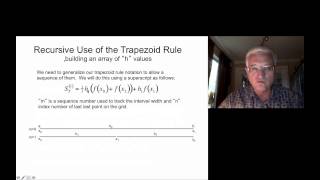
OIT Math 451 session 5.1a: The Trapezoidal Rule
OIT Math 451 session 2.2d: Linked Lists and Measuring Algorithm "Cost"
View Detailed Profile
OIT Math 451 section 0 0   summer 2017

OIT Math 451 section 0 0 summer 2017

OIT 451

OIT Math 451 section 0.0: Introduction and Logistics

OIT Math 451 section 0.0: Introduction and Logistics

THIS INTRODUCTION MODULE IS OUT OF DATE This is the course overview for

OIT Math 451 session 0.1c: Preliminaries : Counting & Induction

OIT Math 451 session 0.1c: Preliminaries : Counting & Induction

Induction as a means to prove proposed formulas and some useful formulas that count the number of computations before they ...

OIT Math 451 section 0.1a: The Origins of Computation

OIT Math 451 section 0.1a: The Origins of Computation

Introduction to Numeric Systems and Computation.

OIT Math 451 session 0.1b: Preliminaries - rational & irrational numbers

OIT Math 451 session 0.1b: Preliminaries - rational & irrational numbers

Understanding the nature of our modern definition of numbers.

OIT Math 451 session 0.2: Algorithms as Solutions

OIT Math 451 session 0.2: Algorithms as Solutions

Well welcome back to

OIT Math 451 section 1.1 : Numeric Representation to Support Automation

OIT Math 451 section 1.1 : Numeric Representation to Support Automation

Numeric representations on moder computers.

OIT Math 451 session 2.0d: Matrix Computation, Singularity & Rank

OIT Math 451 session 2.0d: Matrix Computation, Singularity & Rank

Computational methods for matrices; understanding matrix singularity and rank.

OIT Math 451 session 1.3a: Converting Numbers Among Various Bases

OIT Math 451 session 1.3a: Converting Numbers Among Various Bases

Moving among binary, octal, decimal and hexadecimal number systems in preparation for developing the floating point real ...

Math 451 lecture 0 0

Math 451 lecture 0 0

OIT 451

OIT Math 451 session 5.1a: The Trapezoidal Rule

OIT Math 451 session 5.1a: The Trapezoidal Rule

Improving the "Method of Exhaustion" by substituting rectangles with trapezoids.

OIT Math 451 session 2.2d: Linked Lists and Measuring Algorithm "Cost"

OIT Math 451 session 2.2d: Linked Lists and Measuring Algorithm "Cost"

Reducing the computations needed through the use of linked lists. We will also learn to calculate the cost of algorithms by ...

OIT Math 451 session 7.2:  Runge-Kutta Methods for 1st order Differential Equations

OIT Math 451 session 7.2: Runge-Kutta Methods for 1st order Differential Equations

Improving the first order method by making use of multiple stages and locations for calculating the derivative.

OIT Math 451 session 1.4: Loss of Significance

OIT Math 451 session 1.4: Loss of Significance

How simple

OIT Math 451 session 5.1b-1: The Recursive Trapezoidal Algorithm - part 1

OIT Math 451 session 5.1b-1: The Recursive Trapezoidal Algorithm - part 1

The recursive trapezoidal rule - part 1.

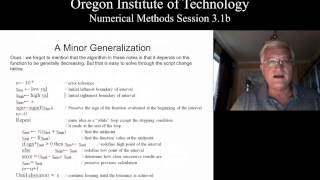
OIT Math 451 session 3.1b: Speed of Convergence: and some Algorithmic Improvements

OIT Math 451 session 3.1b: Speed of Convergence: and some Algorithmic Improvements

Speed of Convergence for the Bisection Method. Improvements to the Bisection Method resulting in the False Position and ...

OIT Math 451 session 3.2a: Newton-Raphson Methods

OIT Math 451 session 3.2a: Newton-Raphson Methods

Developing the Newton-Raphson Method to find a root of a single non-linear equation.

OIT Math 451 session 3.2c: Problems with Multiple Roots and other convergence issues

OIT Math 451 session 3.2c: Problems with Multiple Roots and other convergence issues

Analysis of the Newton-Raphson Algorithm with respect to multiple roots and issues when the function is flat near the root of ...

OIT Math 451 session 5.2: Romberg Integration

OIT Math 451 session 5.2: Romberg Integration

Applying Richardson's method to the trapezoidal rule to obtain Romberg Integration.

OIT Math 451 session 3.3: The Secant Method

OIT Math 451 session 3.3: The Secant Method

Adapting the Newton-Raphson to case where the function being evaluated is available only in table form.