Media Summary: In this video, we learn how to use Hamilton's Method to solve apportionment problems. If you haven't yet watched the introduction ... In this video, we learn how to use Jefferson's Method to solve apportionment problems. If you haven't yet watched the introduction ... In this video, we learn the basic concepts we use to solve apportionment problems. Once you have watched this video, you're ...

Math For Liberal Studies Sequential - Detailed Analysis & Overview

In this video, we learn how to use Hamilton's Method to solve apportionment problems. If you haven't yet watched the introduction ... In this video, we learn how to use Jefferson's Method to solve apportionment problems. If you haven't yet watched the introduction ... In this video, we learn the basic concepts we use to solve apportionment problems. Once you have watched this video, you're ... Liberal Arts Math Solving equations and proportions In this video, we see some examples using instant-runoff voting to find the winner of an election. For more info, visit the In this video, we use the nearest-neighbor algorithm to find a Hamiltonian circuit for a given graph. For more info, visit the

This is the third and final video lecture for

Photo Gallery

Math for Liberal Studies: Sequential Pairwise Voting
Math for Liberal Studies - Lecture 2.5.1 Sequential Pairwise Voting
Math for Liberal Studies: Apportionment -- Webster's Method
Math for Liberal Studies: Apportionment -- Jefferson's Method
Math for Liberal Studies: Apportionment -- Hamilton's Method
Math for Liberal Studies: Apportionment -- Introduction
Liberal Arts Math   Solving equations and proportions
Math for Liberal Studies - Lecture 1.8.2 One-at-a-Time Algorithms
Math for Liberal Studies: Instant-Runoff Voting
Math for Liberal Studies - Lecture 3.1.1 Format and Validity
Math for Liberal Studies: Using the Nearest-Neighbor Algorithm
Math for Liberal Studies - Lecture 2.7.2 Hamilton's Method and Apportionment Paradoxes
View Detailed Profile
Math for Liberal Studies: Sequential Pairwise Voting

Math for Liberal Studies: Sequential Pairwise Voting

In this video, we practice using

Math for Liberal Studies - Lecture 2.5.1 Sequential Pairwise Voting

Math for Liberal Studies - Lecture 2.5.1 Sequential Pairwise Voting

This is the first video lecture for

Math for Liberal Studies: Apportionment -- Webster's Method

Math for Liberal Studies: Apportionment -- Webster's Method

In this video, we learn how to use Hamilton's Method to solve apportionment problems. If you haven't yet watched the introduction ...

Math for Liberal Studies: Apportionment -- Jefferson's Method

Math for Liberal Studies: Apportionment -- Jefferson's Method

In this video, we learn how to use Jefferson's Method to solve apportionment problems. If you haven't yet watched the introduction ...

Math for Liberal Studies: Apportionment -- Hamilton's Method

Math for Liberal Studies: Apportionment -- Hamilton's Method

In this video, we learn how to use Hamilton's Method to solve apportionment problems. If you haven't yet watched the introduction ...

Math for Liberal Studies: Apportionment -- Introduction

Math for Liberal Studies: Apportionment -- Introduction

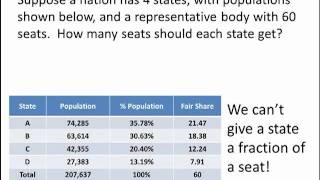
In this video, we learn the basic concepts we use to solve apportionment problems. Once you have watched this video, you're ...

Liberal Arts Math   Solving equations and proportions

Liberal Arts Math Solving equations and proportions

Liberal Arts Math Solving equations and proportions

Math for Liberal Studies - Lecture 1.8.2 One-at-a-Time Algorithms

Math for Liberal Studies - Lecture 1.8.2 One-at-a-Time Algorithms

This is the second video for

Math for Liberal Studies: Instant-Runoff Voting

Math for Liberal Studies: Instant-Runoff Voting

In this video, we see some examples using instant-runoff voting to find the winner of an election. For more info, visit the

Math for Liberal Studies - Lecture 3.1.1 Format and Validity

Math for Liberal Studies - Lecture 3.1.1 Format and Validity

This is the first video lecture for

Math for Liberal Studies: Using the Nearest-Neighbor Algorithm

Math for Liberal Studies: Using the Nearest-Neighbor Algorithm

In this video, we use the nearest-neighbor algorithm to find a Hamiltonian circuit for a given graph. For more info, visit the

Math for Liberal Studies - Lecture 2.7.2 Hamilton's Method and Apportionment Paradoxes

Math for Liberal Studies - Lecture 2.7.2 Hamilton's Method and Apportionment Paradoxes

This is the second video lecture for

Math for Liberal Studies - Lecture 3.5.1 Parity Checksums

Math for Liberal Studies - Lecture 3.5.1 Parity Checksums

This is the first video for

Math for Liberal Studies - Lecture 1.7.1 Maps and Colors

Math for Liberal Studies - Lecture 1.7.1 Maps and Colors

This is the first video lecture for

Math for Liberal Studies - Lecture 1.7.3 Upper and Lower Bounds

Math for Liberal Studies - Lecture 1.7.3 Upper and Lower Bounds

This is the third and final video lecture for